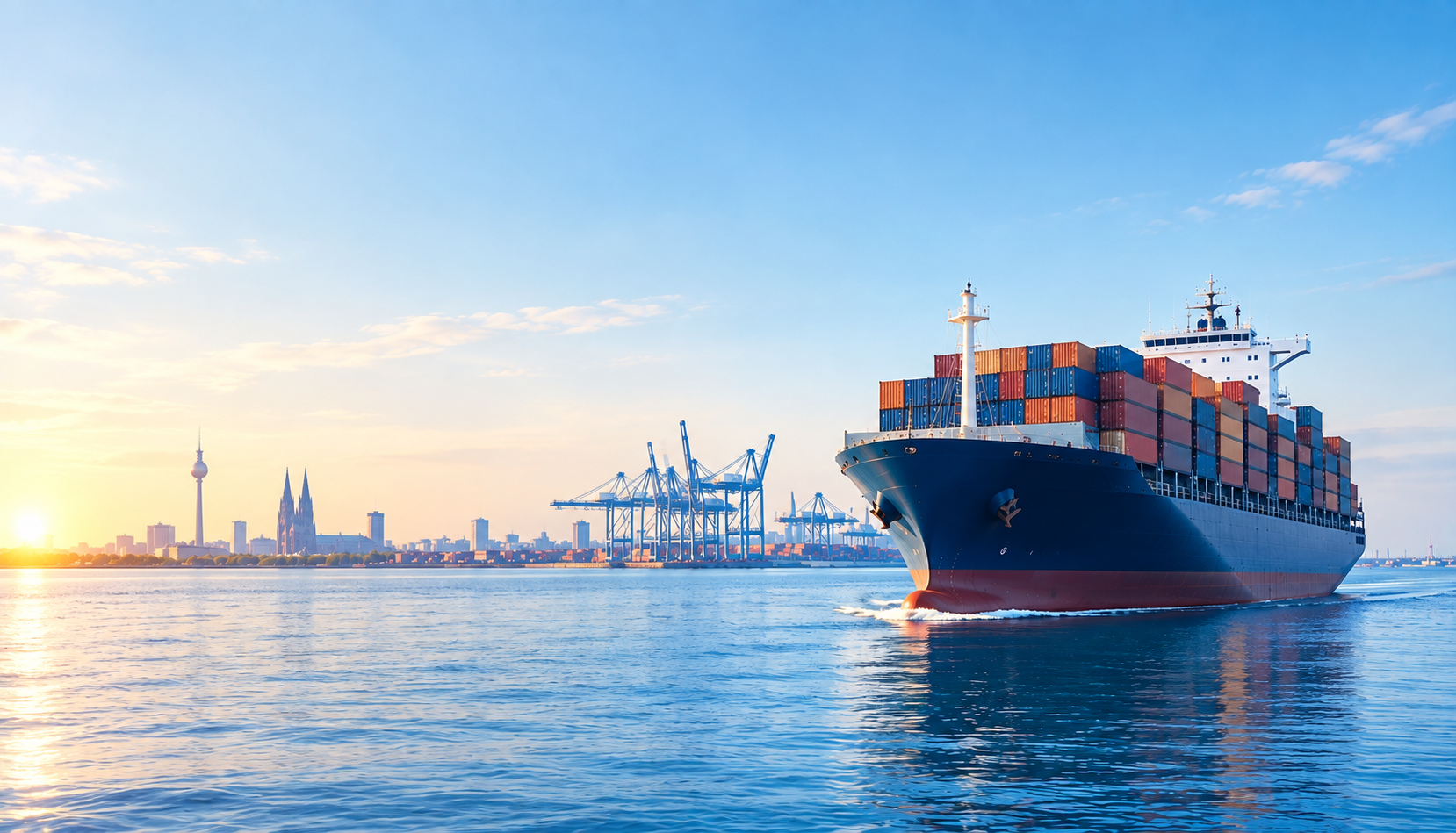
Sea Freight from China to Germany: Costs, Transit Times and Import Process
Sea freight from China to Germany takes around 28 to 35 days via the Suez Canal and around 38 to 48 days via the Cape of Good Hope. The costs are made up of the freight rate, surcharges such as BAF and ETS, terminal handling charges, customs duty, and 19 percent import VAT, plus on-carriage. FR8 Logistik GmbH in Hamburg organizes the import by full container with its own agents in Shanghai and Hong Kong.
China remains Germany's most important supplier: bilateral trade in goods reached around 245 billion euros in 2024, and between January and May 2026 alone, German imports from China rose by 6.2 percent to 72.4 billion euros according to the Federal Statistical Office. The vast majority of these goods arrive by container over sea. Importers therefore keep asking the same three questions: How long does it take, what does it cost, and how does it work?
This guide answers all three in brief. We have described the complete step-by-step process from purchase contract to delivery in our guide to container imports from China. Here, the focus is on the decision basics: transit times per routing, the cost building blocks behind a freight rate, and the points where imports lose time.
28 to 35 days
Ocean leg China to Hamburg via the Suez Canal
245 bn euros
Bilateral trade in goods between Germany and China in 2024
3,879
Projects completed by FR8 Logistik GmbH in 2025
16,388 TEU
Containers loaded by FR8 Logistik GmbH in 2025
How long does sea freight from China to Germany take?
The honest answer: it depends on the routing. Since the Red Sea crisis, carriers decide, service by service, whether a vessel sails through the Suez Canal or diverts via the Cape of Good Hope. The diversion means around 4,000 additional nautical miles and noticeably longer transit times.
The origin port matters too: Shanghai and Ningbo in East China, Shenzhen with the Yantian terminal in South China, Qingdao in the north, and Xiamen are the main gateways. Between North and South China, schedules differ by several days. And you never have to guess where your container currently is: with container tracking, every stage of the ocean leg can be followed, including transshipments and ETA changes.
What does sea freight from China to Germany cost?
A serious answer doesn't use a flat figure, because freight rates change constantly with capacity, season, and routing. You can clearly name the building blocks that make up your total cost. Knowing them lets you compare offers and spot hidden gaps:
- Ocean freight rate: the market-driven core, as a spot or contract rate. On top sit surcharges such as the bunker adjustment factor BAF, the ETS levy for the EU emissions trading system, and, in peak season, surcharges such as PSS or GRI.
- Local charges in China: pre-carriage from the supplier to the port, export clearance and port handling at the origin.
- Terminal charges in Germany: the terminal handling charge (THC) at the arrival port, plus ISPS and documentation fees where applicable.
- Customs and taxes: the duty rate depends on the commodity code of your goods, plus 19 percent import VAT on the customs value.
- On-carriage: the truck or rail transport from the port to the consignee, with a warehouse stop where needed.
- Avoidable extras: demurrage and detention when free time at the terminal or on the equipment is exceeded, and storage fees for delayed pickup.
Importers hold one big lever before booking: the choice between FCL or LCL. Above a certain volume, your own full container is not only more predictable but also the more economical option per cubic meter, because the handling costs of consolidated cargo fall away.


The import process in brief: Four phases to delivery
Phase 1
Booking and pre-carriage in China
After booking, the container is positioned at the supplier or depot, loaded, and delivered to the origin port on time before the cut-off. The agents of FR8 Logistik GmbH in Shanghai and Hong Kong coordinate pre-carriage and loading on site.
Phase 2
Data, ENS and loading
Before loading, the safety-related data under ICS2 must be submitted and accepted. How strictly carriers now enforce this is shown by the rule No MRN, No Load: without a valid MRN, the cargo does not get on board.
Phase 3
Ocean leg and arrival in Hamburg
During the 28 to 35 days via Suez or 38 to 48 days via the Cape, import preparation runs in parallel: checking documents, preparing the import declaration, scheduling on-carriage. After arrival, the vessel is discharged, and customs release follows.
Phase 4
On-carriage, warehousing and delivery
The released container moves to the consignee by truck or rail. Anyone who does not need the full quantity at once uses warehousing in Hamburg: unloading, storage, and distribution at your own pace, with interim storage in a bonded warehouse on request.
Where imports lose time and how to avoid it
Most delays do not happen at sea but at the interfaces. We see four patterns again and again: First, data delivered too late, which since ICS2 no longer just means penalties but exclusion from loading. Second, tightly calculated pre-carriage in China, where a missed cut-off immediately costs a week until the next sailing. Third, transshipment connections that break when schedules shift. Fourth, missing preparation at the destination port, when the import declaration or on-carriage is only organized after arrival while free time is already running.
All four points share one solution: a process in which booking, data, customs and on-carriage are thought through together from the start, instead of one after another by different parties.
What FR8 Logistik GmbH takes care of for your China import
FR8 Logistik GmbH is an internationally active sea freight forwarder based in Hamburg, a member of the DSLV (German Association of Freight Forwarding and Logistics) and the Association of Hamburg Freight Forwarders (VHSp). In 2025, we completed 3,879 projects and loaded 16,388 TEU. For the China trade, we work with our own agents in Shanghai and Hong Kong, who manage pre-carriage and loading directly on site. In Hamburg, we handle customs clearance, on-carriage and, on request, warehousing from a single source, with one fixed contact person instead of a ticket system.
If you want to know your specific import costs and when it arrives, send us the key details of your cargo and your target date. You can request a quote and receive a concrete response within 24 hours.
Frequently asked questions
How long does sea freight from China to Germany take?
On the Suez Canal routing, the ocean leg from China to Hamburg takes around 28 to 35 days. If the carrier diverts via the Cape of Good Hope, it is around 38 to 48 days. Pre-carriage in China, customs clearance, and on-carriage in Germany come on top, so door-to-door you should plan several additional days, up to a full week, depending on pickup location and schedules.
How much does a container from China to Germany cost?
The total cost is made up of several building blocks: the market-driven ocean freight rate with surcharges such as BAF, the ETS levy or seasonal surcharges, local charges at the port of origin, terminal handling charges (THC) in Hamburg, customs duty depending on the commodity code plus 19 percent import VAT, and on-carriage to the consignee. Since rates fluctuate constantly, a specific request with cargo details and target date pays off.
Which Chinese ports matter for exports to Germany?
The most important origin ports are Shanghai and Ningbo in East China, Shenzhen with the Yantian terminal and Guangzhou in South China, plus Qingdao in the north and Xiamen. On the German side, most services call Hamburg and Bremerhaven, with Wilhelmshaven adding deepwater capacity. The right port depends on your supplier's location: short pre-carriage saves time and reduces the risk of missed cut-offs.
Does my container sail directly to Hamburg or is it transshipped?
Both happen. Direct services run from China to Hamburg without transshipment and are more predictable. On transshipment services, the container is transferred to another vessel en route, for example in Singapore or Tangier. That typically adds several days to the transit time and increases the risk of missing a connection. Which service is booked is stated in the schedule and can be followed via container tracking.
Which documents do I need for imports from China?
The basics are the commercial invoice, the packing list, and the bill of lading. For the import declaration in Germany, you need an EORI number and the correct commodity code. Depending on the product, evidence such as declarations of conformity may be required. Since the full application of ICS2, the safety-related ENS data must also be submitted and accepted in time; otherwise, the container will not be loaded.
Sea freight from China to Germany is plannable when three things come together: realistic transit times per routing instead of best-case promises, transparency about all cost building blocks from the freight rate to import VAT, and a process that considers data, customs and on-carriage from the start. FR8 Logistik GmbH combines these points with its own agents in Shanghai and Hong Kong and the handling in Hamburg into one continuous chain.

Sea freight from China to Germany is plannable when three things come together: realistic transit times per routing instead of best-case promises, transparency about all cost building blocks from the freight rate to import VAT, and a process that considers data, customs and on-carriage from the start. FR8 Logistik GmbH combines these points with its own agents in Shanghai and Hong Kong and the handling in Hamburg into one continuous chain.