
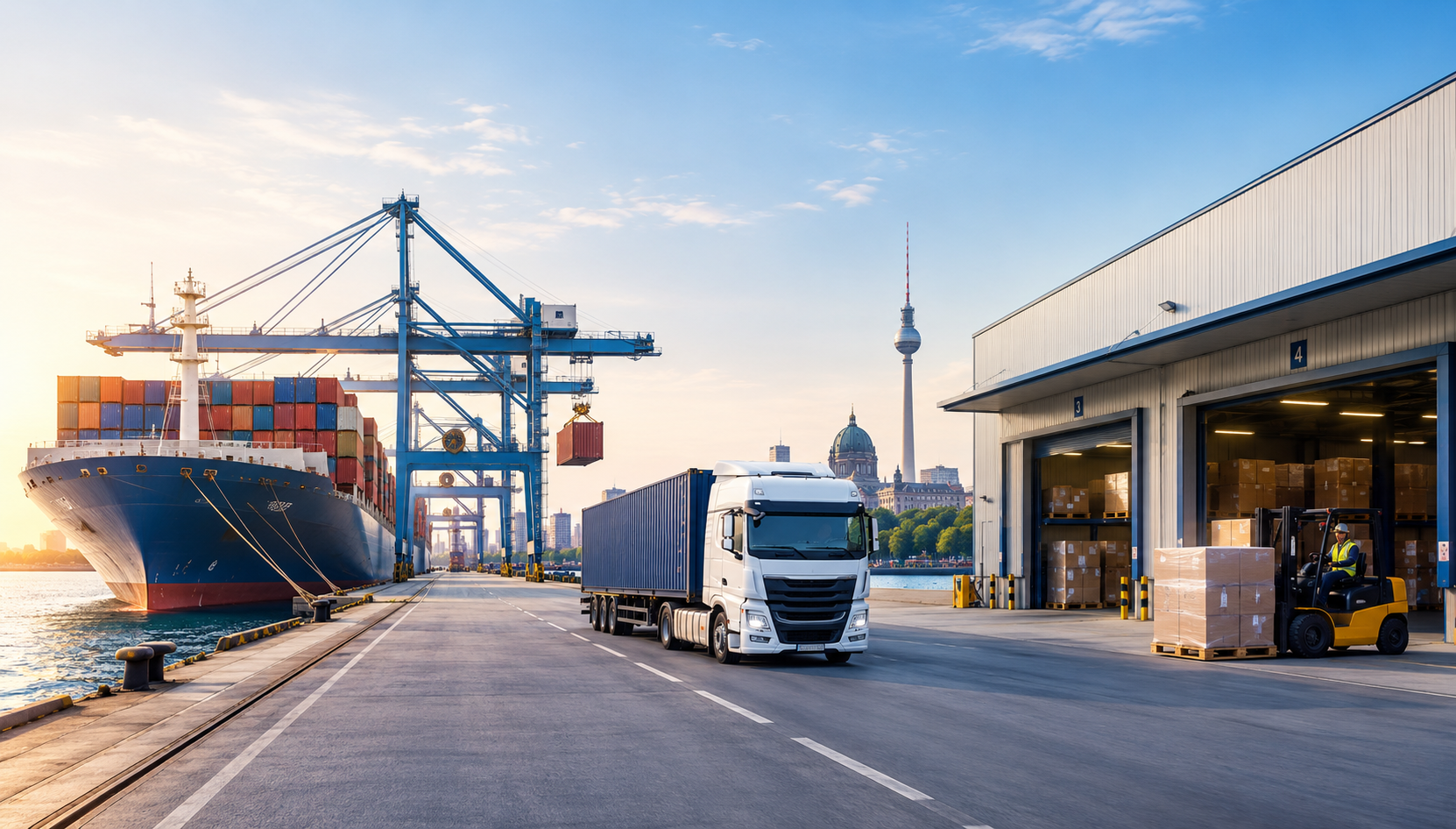
From Port to Warehouse: How Import Cargo Moves Through Germany
After discharge from the vessel, an import container in Germany passes through five stations: customs clearance and release at the terminal, pickup within the free time, on-carriage by truck, rail, or inland barge, then direct delivery or unloading into a warehouse, followed by distribution. FR8 Logistik GmbH in Hamburg organizes this chain from a single source, from customs clearance and container transport to warehousing.
The ocean leg gets the attention, but the last 150 kilometers decide delivery reliability. The Port of Hamburg handled around 4.2 million TEU in the first half of 2025 alone, up 9.3 percent, and moved 2.6 million TEU of that into the hinterland. Every one of those containers has to pass through the same bottleneck after arrival: terminal, free time, transport mode, delivery.
This is exactly the stretch where the costs arise that no freight rate mentions: demurrage, waiting times, missed unloading slots. This guide shows how import cargo moves through Germany after vessel arrival, which transport mode fits when, and when the detour via a warehouse is actually the faster route.
4.2m TEU
Container throughput in the Port of Hamburg in H1 2025, up 9.3 percent
2.6m TEU
Containers in the Port of Hamburg's hinterland transport in H1 2025
3,879
Projects completed by FR8 Logistik GmbH in 2025
16,388 TEU
Containers loaded by FR8 Logistik GmbH in 2025
Station 1: Terminal, release, and the ticking clock
With discharge from the vessel, the container is physically in Germany, but it is not yet available. Only once customs clearance is in place and the carrier releases the container against the bill of lading may it leave the terminal. What happens at the quay during these hours and days, and why experience makes the difference there, is covered in our guide to container arrival.
From discharge onwards, the free time runs: a few days during which the container may stand at the terminal free of charge. After that, demurrage becomes due, and after pickup the second clock, detention, ticks until the empty return. Anyone who only organizes the on-carriage after arrival gives away exactly the days that get expensive later.
Station 2: Truck, rail or inland barge
Three transport modes are available for the way into the hinterland, and Hamburg is built for all three: the port is considered Europe's largest rail port, and around half of its hinterland containers move by rail. Which way is right is decided by distance, volume and time pressure:
Mode: Truck
Strengths: Flexible, fast over short distances, reaches every ramp
Typical use: Area around the port, urgent shipments, last mile to the consignee
Mode: Rail
Strengths: High capacity, plannable, significantly better CO2 footprint
Typical use: Long runs to inland terminals, regular volumes to southern and western Germany
Mode: Inland barge
Strengths: Large volumes per departure, economical with plannable lead time
Typical use: Traffic along the Elbe and Rhine without tight deadlines
In practice it is rarely either-or: the container travels by rail to an inland terminal and by truck for the last kilometers to the ramp. When such combinations pay off for mid-sized companies is the subject of our guide to multimodal transport. Decisive for scheduling: the mode is fixed before the vessel arrives, not after, because rail slots and driver capacity are scarce.
After discharge from the vessel, an import container in Germany passes through five stations: customs clearance and release at the terminal, pickup within the free time, on-carriage by truck, rail, or inland barge, then direct delivery or unloading into a warehouse, followed by distribution. FR8 Logistik GmbH in Hamburg organizes this chain from a single source, from customs clearance and container transport to warehousing.
The ocean leg gets the attention, but the last 150 kilometers decide delivery reliability. The Port of Hamburg handled around 4.2 million TEU in the first half of 2025 alone, up 9.3 percent, and moved 2.6 million TEU of that into the hinterland. Every one of those containers has to pass through the same bottleneck after arrival: terminal, free time, transport mode, delivery.
This is exactly the stretch where the costs arise that no freight rate mentions: demurrage, waiting times, missed unloading slots. This guide shows how import cargo moves through Germany after vessel arrival, which transport mode fits when, and when the detour via a warehouse is actually the faster route.
4.2m TEU
Container throughput in the Port of Hamburg in H1 2025, up 9.3 percent
2.6m TEU
Containers in the Port of Hamburg's hinterland transport in H1 2025
3,879
Projects completed by FR8 Logistik GmbH in 2025
16,388 TEU
Containers loaded by FR8 Logistik GmbH in 2025
Station 1: Terminal, release, and the ticking clock
With discharge from the vessel, the container is physically in Germany, but it is not yet available. Only once customs clearance is in place and the carrier releases the container against the bill of lading may it leave the terminal. What happens at the quay during these hours and days, and why experience makes the difference there, is covered in our guide to container arrival.
From discharge onwards, the free time runs: a few days during which the container may stand at the terminal free of charge. After that, demurrage becomes due, and after pickup the second clock, detention, ticks until the empty return. Anyone who only organizes the on-carriage after arrival gives away exactly the days that get expensive later.
Station 2: Truck, rail or inland barge
Three transport modes are available for the way into the hinterland, and Hamburg is built for all three: the port is considered Europe's largest rail port, and around half of its hinterland containers move by rail. Which way is right is decided by distance, volume and time pressure:
Mode: Truck
Strengths: Flexible, fast over short distances, reaches every ramp
Typical use: Area around the port, urgent shipments, last mile to the consignee
Mode: Rail
Strengths: High capacity, plannable, significantly better CO2 footprint
Typical use: Long runs to inland terminals, regular volumes to southern and western Germany
Mode: Inland barge
Strengths: Large volumes per departure, economical with plannable lead time
Typical use: Traffic along the Elbe and Rhine without tight deadlines
In practice it is rarely either-or: the container travels by rail to an inland terminal and by truck for the last kilometers to the ramp. When such combinations pay off for mid-sized companies is the subject of our guide to multimodal transport. Decisive for scheduling: the mode is fixed before the vessel arrives, not after, because rail slots and driver capacity are scarce.
Station 3: Direct to the consignee or via the warehouse?
Direct delivery is the shortest route: container to the plant, unload, empty container back. It works when the consignee can absorb the full load at once and a ramp with staff is available at the agreed slot. As soon as one of these conditions wobbles, the direct route becomes a risk: a container waiting in front of an occupied ramp costs money, and an empty container returned too late costs detention.
The alternative is unloading into a warehouse near the port. The container is positioned, unloaded, and returned empty quickly, before the deadlines bite. The goods are inspected, palletized, stored and distributed at the pace the consignee actually needs. How this building block works in detail, from devanning and FIFO, LIFO and JIT to the bonded warehouse, is covered in our guide to warehousing in Hamburg.
The pacemaker: scheduling before arrival
Phase 1
Before arrival: follow the ETA and schedule
While the vessel is still at sea, container tracking provides the basis for planning: ETA, transshipments, shifts. On this basis, customs documents are prepared, the trucker or rail slot is booked, and the unloading slot at the consignee is fixed.
Phase 2
Discharge and customs release
The container is discharged from the vessel, the import declaration is processed, and the carrier releases the container. From now on, the free time at the terminal is running.
Phase 3
Pickup within the free time
Truck, rail or inland barge take over the container at the terminal. When slots are scarce, early booking decides whether the pickup falls within the free time.
Phase 4
Delivery or unloading into the warehouse
Direct delivery to the plant, or devanning at the warehouse with incoming goods inspection. The empty container returns to the depot before the detention deadline expires.
Phase 5
Distribution at your own pace
Goods are picked from stock and distributed by truck or container, as a complete delivery, in partial quantities, or via cross-docking straight from goods-in to goods-out.
What FR8 Logistik GmbH takes care of along this route
FR8 Logistik GmbH is an internationally active sea freight forwarder based in Hamburg, a member of the DSLV (German Association of Freight Forwarding and Logistics) and the Association of Hamburg Freight Forwarders (VHSp). In 2025, we completed 3,879 projects and loaded 16,388 TEU. After customs clearance, we take over the container transport by truck and rail to the consignee's ramp, on request, with unloading, storage, and distribution through our warehousing. One fixed contact person coordinates the entire chain; no ticket system.
The biggest lever lies in the timing: because sea freight, customs and on-carriage converge with us, the hinterland transport is scheduled before the vessel is moored. You can request a quote and receive a concrete response within 24 hours.
Frequently asked questions about import cargo moving through Germany
How does an import container get from the Port of Hamburg to the consignee?
After discharge from the vessel, the container stays at the terminal until customs clearance and the carrier's release are in place. It is then picked up within the free time, by truck, rail, or inland barge. The truck covers short distances and the last mile, rail covers long runs to inland terminals, and the barge moves plannable volumes along the waterways. At destination, the cargo is delivered directly or unloaded into a warehouse.
What do free time, demurrage and detention mean?
Free time is the period during which a container may stand at the terminal, or the equipment may be used, without extra charges. Demurrage becomes due when the full container stays at the terminal too long; detention when the container is returned empty too late after pickup. Both can be avoided when pickup, unloading, and empty return are scheduled before the vessel arrives.
Truck, rail, or barge: which on-carriage is right?
That depends on distance, volume, and time pressure. The truck is flexible and usually fastest over short distances, and it reaches every delivery address. Rail plays to its strengths on long runs to inland terminals, especially for regular volumes, and saves CO2. The inland barge suits large, plannable volumes along the Elbe and Rhine. In many cases, combining modes is the most economical solution.
Is unloading into a warehouse worth it instead of direct delivery?
Direct delivery fits when the consignee can absorb the entire container load at once. A warehouse near the port pays off when only partial quantities are needed, when incoming goods have to be inspected or repacked, or when the container has to be returned empty quickly to avoid detention. The goods are then unloaded, stored, and picked and distributed at the consignee's own pace.
Does FR8 Logistik also handle on-carriage within Germany?
Yes. After customs clearance in Hamburg, FR8 Logistik GmbH organizes the complete on-carriage: container transport by truck or rail to the consignee, on request with unloading, storage and distribution through its own warehousing in Hamburg. Sea freight, customs, transport and warehousing come from a single source, coordinated by one fixed contact person instead of a ticket system.

Between quay and ramp is where it is decided whether an import arrives on time and without extra costs. Knowing the free times, fixing the transport mode before vessel arrival, and buffering via a warehouse where needed takes the risk out of the on-carriage. FR8 Logistik GmbH combines customs clearance, container transport by truck and rail, and warehousing in Hamburg into one continuous chain, from terminal to distributed goods.