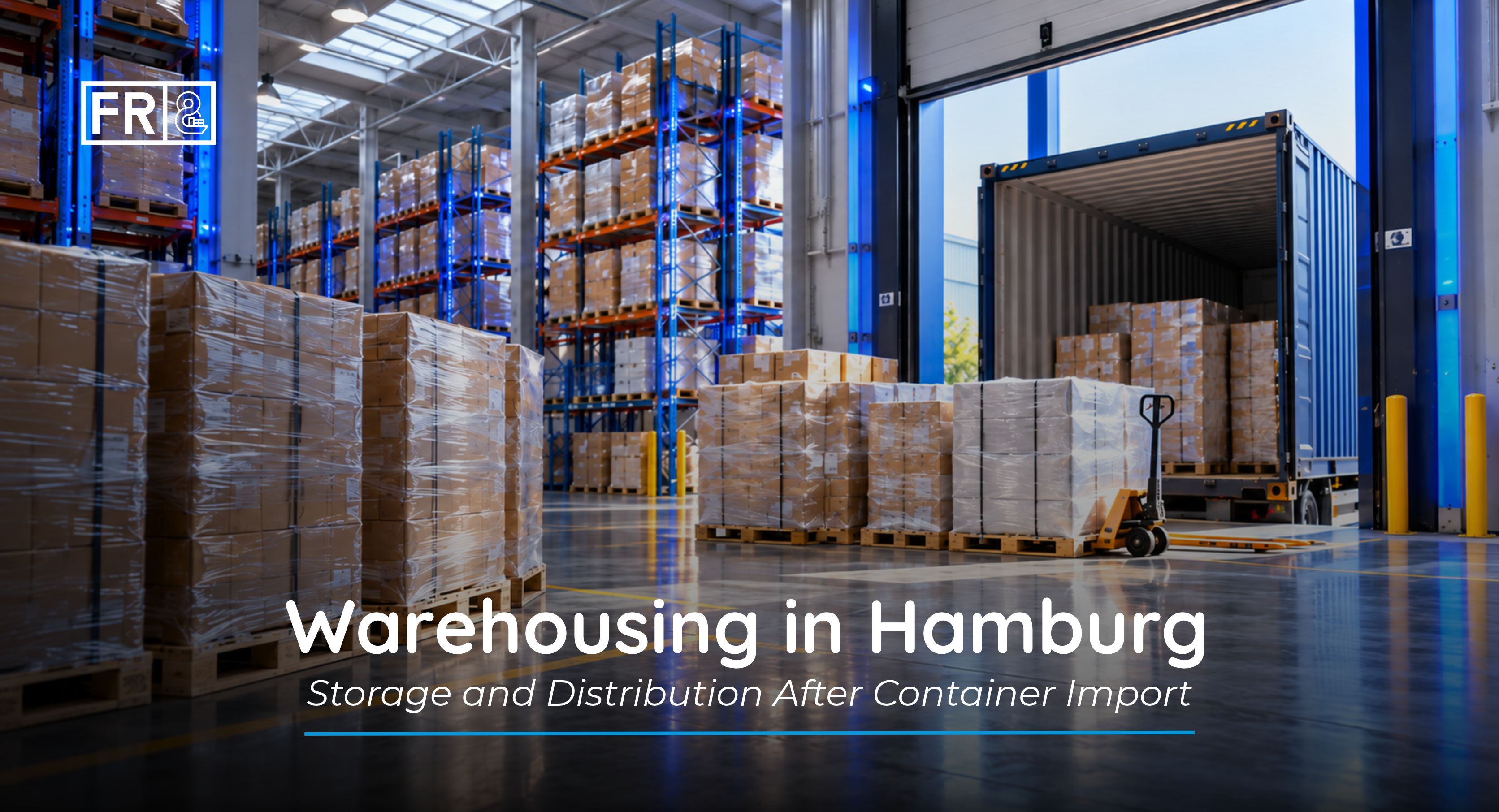
Warehousing Logistics in Hamburg: Storage and Distribution After Container Import
Warehouse logistics in Hamburg: Storage and distribution after container import
After customs release, the second half of the logistics chain begins for an import container: unloading (devanning), incoming goods inspection, palletizing, storage, and distribution. FR8 Logistik GmbH offers this warehousing in Hamburg as part of the import chain, including interim storage in a bonded warehouse, picking, photo documentation, and distribution by container or truck. Sea freight, customs, and warehousing come from a single source.
Most imports are planned carefully up to the port of Hamburg: departure, routing, customs clearance. What happens afterwards, however, is just as decisive for cost and delivery reliability. A container that sits at the terminal without a plan after release generates idle time. Goods that are trucked to your own facility in full, although only part of the volume is needed, tie up floor space and capital.
Demand is growing with the trade flows themselves: container throughput in the port of Hamburg's India trade rose by 49.2 percent in 2025, and depending on the situation in the Red Sea, transit times from Asia can vary by up to 16 days. Importers therefore need a buffer between the vessel and their own production or sales operation. That is exactly the job of warehousing after container import. This guide walks through the process step by step.
Why logistics does not end at the quay
Three situations make a warehouse after import indispensable for many companies. First, transit time variance: when shipments arrive earlier or later depending on the routing situation, a buffer warehouse absorbs the difference without your own production having to replan. Second, partial withdrawal: importers of a full container rarely need the entire quantity at once. Stored and picked, the goods reach your site at the pace at which they are actually needed. Third, the floor space question: warehouse space in metropolitan areas is scarce, and peak season inbound waves overwhelm any fixed capacity.
Add to that an operational point that is often underestimated: an import container has free time at the terminal and on the equipment. Anyone who has not prepared the onward logistics pays demurrage and detention. A well-rehearsed sequence of release, pickup, and unloading avoids exactly that.
The process: From cleared container to distributed goods
- Phase 1
- Customs clearance and pickup: After arrival in Hamburg, the import declaration and release are processed. How tightly customs data and transport are now interlinked is shown by the carrier rule No MRN, No Load: without accepted customs data, no container moves. Once release is granted, the container is picked up before free time expires.
- Phase 2
- Unloading (devanning): The container is unloaded, whether palletized goods, roll goods, or vehicles. The goods are counted, checked for transport damage, and recorded with photo documentation where required. The empty container returns to the depot before detention becomes due.
- Phase 3
- Incoming goods inspection and preparation: Palletizing or repacking, labeling, and where required anonymizing or stretch wrapping: the goods are prepared the way the destination needs them, whether your own plant, a retail warehouse, or the end customer.
- Phase 4
- Storage under the right principle: Goods are stored under the principle that fits the cargo: FIFO for goods with shelf life or batch logic, LIFO where the handling structure allows it, JIT-oriented for production-related call-offs. Stock levels and goods movements are recorded digitally.
- Phase 5
- Picking and distribution: Goods are picked from stock as needed and distributed by truck or container. Where no storage is required, the goods move directly from goods-in to goods-out via cross-docking.
The services at a glance
Bonded warehouse: When duties can wait
One building block deserves special attention: the bonded warehouse. Non-Union goods are stored there without import duties becoming due at the time of storage. Duties only arise upon release into free circulation. For importers, that means liquidity stays in the company as long as the goods are on the shelf, and goods that later move on to a third country can leave the warehouse without import clearance in the EU.
This becomes interesting whenever sales and import fall apart in time, with seasonal assortments, with uncertain duty developments on individual trade lanes, or with merchandise destined for several markets. FR8 Logistik GmbH covers this building block through interim storage in a bonded warehouse and T1 handling, embedded in customs clearance and warehousing from a single source.
Who benefits from warehousing after import
The clearest beneficiaries are companies with growing overseas volumes. Anyone scaling up container imports from India, the fastest growing trade lane in the port of Hamburg, often imports larger volumes at longer intervals and distributes them over weeks. Without a buffer, that fluctuation hits your own facility unfiltered.
Warehousing works in both directions, though. Exporters use it to consolidate goods from several plants, pack them container-ready, and deliver them on schedule. In the USA export by sea, for example, punctual delivery before the cut-off decides whether the booked sailing is kept. A warehouse close to the port makes this step plannable.


What FR8 Logistik GmbH takes off your hands
FR8 Logistik GmbH is an internationally active sea freight forwarder based in Hamburg, a member of the DSLV (German Association of Freight Forwarding and Logistics) and the Association of Hamburg Freight Forwarders (VHSp). In 2025 we completed 3,879 projects and loaded 16,388 TEU. With warehousing, we close the chain between vessel and consignee: FCL sea freight, customs clearance, and storage interlock, coordinated by one fixed contact person. No ticket system, no interface losses between multiple providers.
Whether unloading and direct distribution, longer-term storage with picking, or interim storage in a bonded warehouse: we develop the warehousing concept to match your goods flow. You can request a quote and receive a concrete response within 24 hours.
Frequently asked questions
Which warehousing services does FR8 Logistik offer in Hamburg?
FR8 Logistik GmbH offers container loading and unloading (stuffing and unstuffing), palletizing and repacking, incoming and outgoing goods inspection with photo documentation, storage based on FIFO, LIFO or JIT principles, picking, labeling and further value added services, packaging management, cross-docking, and distribution by container or truck in Hamburg. Customs clearance and warehousing come from a single source.
What happens during container unloading (devanning)?
During devanning, the import container is unloaded after customs release. The goods are removed, checked for damage, counted, and recorded with photo documentation where required. They are then palletized or repacked and either put into storage or staged directly for onward distribution. Palletized goods are handled as well as roll goods and vehicles. The empty container then returns to the depot.
What is a bonded warehouse and does FR8 offer this option?
In a bonded warehouse, non-Union goods are stored without import duties becoming due at the time of storage. Duties only arise when goods are released into free circulation. This preserves liquidity and creates flexibility, for example when sales planning is uncertain or when goods will later move on to third countries. FR8 Logistik GmbH offers interim storage in a bonded warehouse and T1 handling as part of its customs services.
Does FR8 also handle order picking and distribution?
Yes. After storage, FR8 Logistik GmbH picks your goods as needed, takes care of labeling, palletizing or repacking, and organizes distribution by container or truck. Cross-docking is also possible, meaning direct handling without longer storage. Goods movements are recorded digitally, so you keep an overview of stock levels and goods flows at all times.
Why does it pay off to book sea freight and warehousing with the same partner?
Because the interfaces disappear. When sea freight, customs clearance and warehousing come from a single source, customs release, delivery, unloading and storage are coordinated in time. There are no coordination losses between several providers, no duplicate data transfers, and one fixed contact person for the entire chain. This reduces idle times, sources of error, and internal coordination effort.

Container import does not end at the quay. Unloading, inspection, storage, picking, and distribution jointly decide whether a supply chain produces cost or creates buffer. With warehousing in Hamburg, FR8 Logistik GmbH connects these steps with sea freight and customs clearance into one continuous chain, from vessel to distributed goods, with one fixed contact person and digitally recorded goods flows.