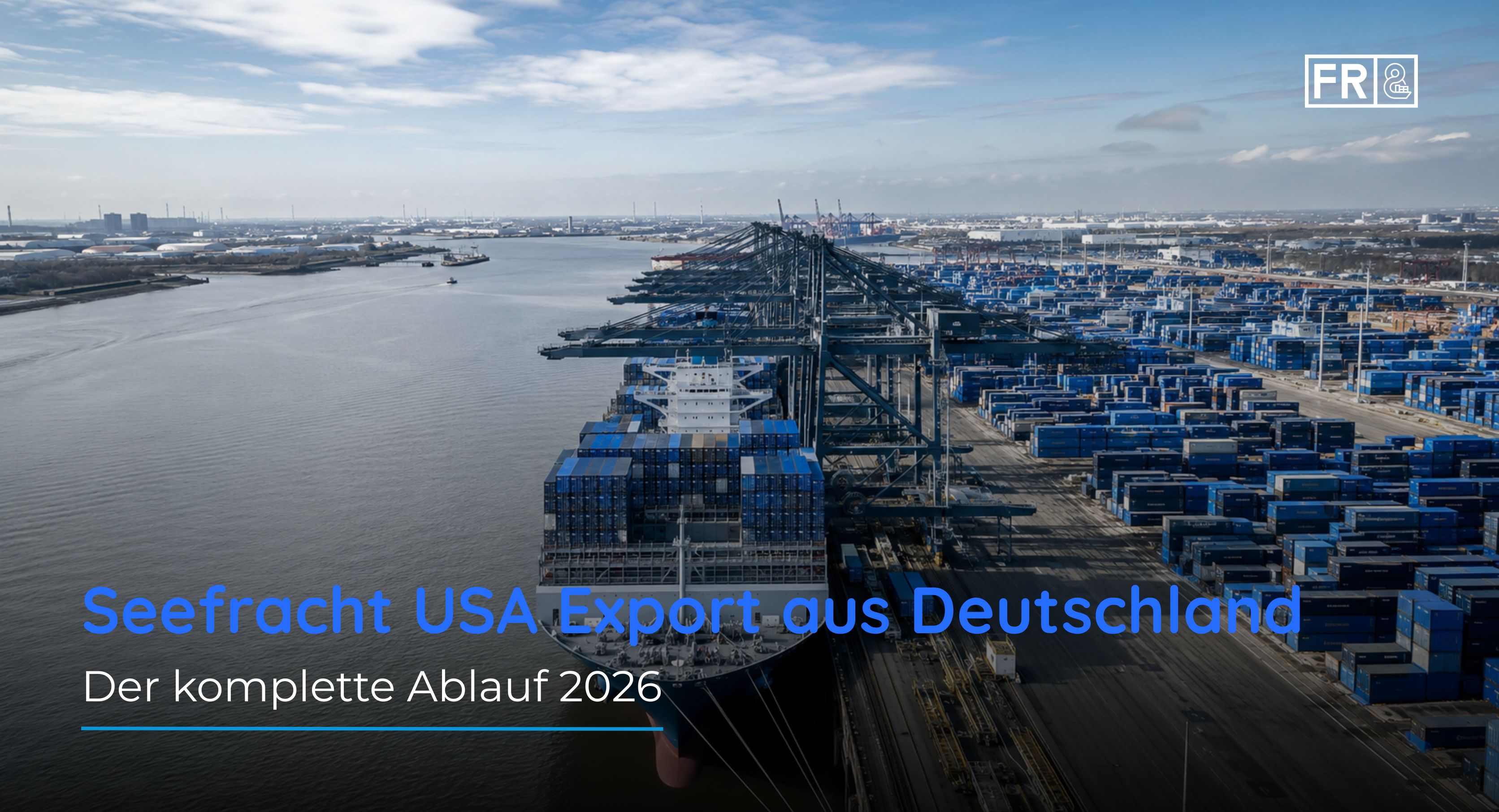
Seefracht USA Export aus Deutschland: Der komplette Ablauf 2026
Sea Freight USA Export from Germany: The Complete 2026 Guide
Exporting by sea from Germany to the USA follows five steps: booking and choosing the Incoterm, pre-carriage and loading in Hamburg, export customs clearance via ATLAS, the transatlantic voyage to the US coast (around 9 to 18 days depending on destination), and US customs clearance and delivery. FR8 Logistik GmbH manages this process as a Hamburg sea freight forwarder with a fixed contact and complete export documentation.
The USA is Germany's most important export market. Despite changing trade conditions and new US tariff policy, the transatlantic corridor remains one of the world's most significant trade routes. For German companies exporting machinery, vehicle parts, chemical products or consumer goods to the USA, a smooth sea freight process determines delivery reliability and cost.
In 2026, care matters more than ever. US customs rules are strict, security pre-filing deadlines are non-negotiable, and a single incorrect export document can hold up a shipment. This guide walks you through the entire process, from booking in Germany to delivery in the USA, and explains the points that matter most when exporting to the United States.
Step 1: Booking and choosing Incoterms
Every US export starts with the choice of Incoterm. It defines who covers which leg of the transport and at what point risk passes from seller to buyer. For ocean export to the USA, FOB (Free on Board), CFR (Cost and Freight) and CIF (Cost, Insurance and Freight) are common, as is DDP (Delivered Duty Paid) if you want to offer your US customer a delivered, duty-paid shipment to the door.
The choice has practical consequences. Under DDP, you as the German exporter take on US import clearance and need a structure for it on the ground. Under FOB, your responsibility ends once the goods are on board at the origin port. Which clause makes sense should be settled with the US customer before signing the contract. For full container exports to the USA, FR8 Logistik GmbH advises on the right clause before you commit.
Step 2: Which port and which connection?
Germany exports to the USA mainly through its North Sea ports. Hamburg is the central hub, with weekly direct services from major carriers to the US East Coast. The right US destination port depends on where in the USA your goods need to arrive.
For rolling cargo and vehicles, Bremerhaven can be the right port of departure, as it is Europe's leading RoRo gateway. If your production site is inland, FR8 arranges pre-carriage by road or rail to the port. We coordinate pre- and on-carriage within Germany so the timing matches your booked sailing.
Step 3: Export customs clearance via ATLAS
Before goods leave the country, they must be declared for export with German customs. This is done electronically through the ATLAS export system. In the USA, the corresponding export filing runs through the Automated Export System (AES), which processes the Electronic Export Information. For German exporters, the correct export declaration in Germany is the decisive first step.
One important difference from trade inside free trade areas: there is no free trade agreement between the EU and the USA. Preferential certificates such as EUR.1 or ATR, which you may know from other markets, do not apply here. Instead, import into the USA is governed by HTS tariff classification. Correct commodity classification is therefore the foundation for a smooth US import.
Good to know: For US import, the ISF security pre-filing (Importer Security Filing, also 10+2) is mandatory. It must be on file with US Customs (CBP) before the vessel is loaded at the origin port. The US importer is usually responsible, but the data has to be ready in time. FR8 coordinates the required details with all parties so the deadline is reliably met.
Step 4: Transatlantic voyage and 2026 transit times
After loading, the ocean voyage across the North Atlantic begins. Transit time depends on the destination port and the chosen connection. The following are guideline figures for direct services from Hamburg:
- Hamburg to the US East Coast (New York, Newark): around 9 to 14 days
- Hamburg to the Southeast (Savannah, Charleston): around 12 to 18 days
- Hamburg to the US Gulf Coast (Houston): longer, being further south
- Hamburg to the US West Coast (via the Panama Canal): the longest option
Total planning involves more than the sea voyage alone. Add booking lead time, pre-carriage to the German port, port handling, US customs clearance and on-carriage in the USA. Seasonal factors such as the North Atlantic storm season from November to March or the US hurricane season can affect transit times. For useful background on how wider conditions shape capacity, the article on how geopolitical conditions affect capacity and routing is worth reading, since rerouting on other lanes ties up vessel space and indirectly affects Atlantic services too.
Step 5: US customs clearance and delivery
On arrival at the US port, import clearance is handled by US Customs and Border Protection (CBP). The US importer, or a customs broker acting for them, files the import entry, classifies the goods by HTS code and pays the applicable US duties. For formal entries above a certain value, a customs bond is also required.
For this step to run smoothly, the export documents from Germany must be complete and correct. A clean commercial invoice with HTS classification and country of origin, an accurate packing list and a correct bill of lading form the basis. Errors here cause delays that become expensive in a tight supply chain. For exporters who want to store or consolidate goods before shipping, FR8 also offers warehousing and customs clearance in Hamburg from a single source.


What FR8 Logistik GmbH does for your US export
FR8 Logistik GmbH is an international sea freight forwarder based in Hamburg. As a member of the DSLV (German Freight Forwarding and Logistics Association) and the Association of Hamburg Freight Forwarders (VHSp), we work to the recognised quality standards of the German freight forwarding industry. In 2025 we completed 3,879 projects and loaded 16,388 TEU.
For US export, that means in practice: you have one fixed contact who handles your shipment from booking to loading, manages export customs clearance via ATLAS, and aligns the data needed for ISF and US import with all parties. No ticket system, no switching between agents, just a colleague who knows your route and reacts immediately when something changes.
Through our sea freight services we offer full containers in all common types, from 20-foot and 40-foot standard to High Cube, plus flat rack and open top for oversized industrial goods. If you are planning an export to the USA, tell us about your shipment and you will receive a concrete response within 24 hours.
US export sea freight checklist: set the Incoterm, choose the destination port and connection, clarify the HTS classification of the goods, prepare a complete commercial invoice and packing list, file the export declaration via ATLAS, provide ISF data in time, align with the US importer and their customs broker, and plan on-carriage in the USA.
Frequently asked questions
How long does sea freight from Germany to the USA take?
Transit time depends on the destination port. From Hamburg to the US East Coast, such as New York or Newark, a direct service typically takes around 9 to 14 days. Southeastern ports like Savannah or Charleston run around 12 to 18 days. The US Gulf Coast and the US West Coast via the Panama Canal take longer. Add booking lead time, pre-carriage to the German port, US customs clearance and final delivery. FR8 Logistik GmbH advises on the best current connection at every booking.
What is the AES export declaration and when is it needed?
AES stands for the Automated Export System, through which Electronic Export Information is filed in the United States. On the German side, the export declaration is filed through the customs ATLAS export system. Goods leaving Germany for the USA must be declared for export with German customs, and depending on value and commodity type, additional documents may be required. FR8 Logistik GmbH handles the export customs process and ensures all declarations are complete and filed on time.
What is ISF 10+2 for exports to the USA?
ISF stands for Importer Security Filing, also known as 10+2. It is a security pre-declaration that must be filed with US Customs and Border Protection (CBP) for ocean shipments to the USA before the vessel is loaded at the origin port. The US importer is usually responsible, but the data must be ready in time. A late or missing ISF can lead to penalties and delays. FR8 coordinates the required data with all parties so the deadline is met.
Do EUR.1 or ATR certificates apply when exporting to the USA?
No. There is no free trade agreement between the European Union and the USA, so preferential certificates such as EUR.1 or ATR do not apply to US exports. Instead, import into the USA is governed by US tariff classification (HTS) and the applicable US duty rates. FR8 Logistik GmbH advises on the correct documentation and checks which certificates your specific goods actually require.
Which ports does FR8 use to export to the USA?
FR8 Logistik GmbH handles sea freight exports to the USA mainly through the Port of Hamburg, with direct services from major carriers to the US East Coast, including New York and Newark, as well as Savannah, Charleston, Norfolk and Houston. For certain shipments such as vehicles or rolling cargo, Bremerhaven may be the right port of departure. The best connection for your shipment depends on destination region, commodity and schedule.

Sea freight export to the USA is a structured process where correct documentation and compliance with US rules determine success. Plan Incoterms, ports, export customs and ISF correctly from the start and you avoid delays. As a Hamburg sea freight forwarder with over 25 years of experience, FR8 Logistik GmbH manages your US export with complete export handling and a fixed contact for every shipment.