
Customs Warehousing: Why goods don't always have to be cleared immediately
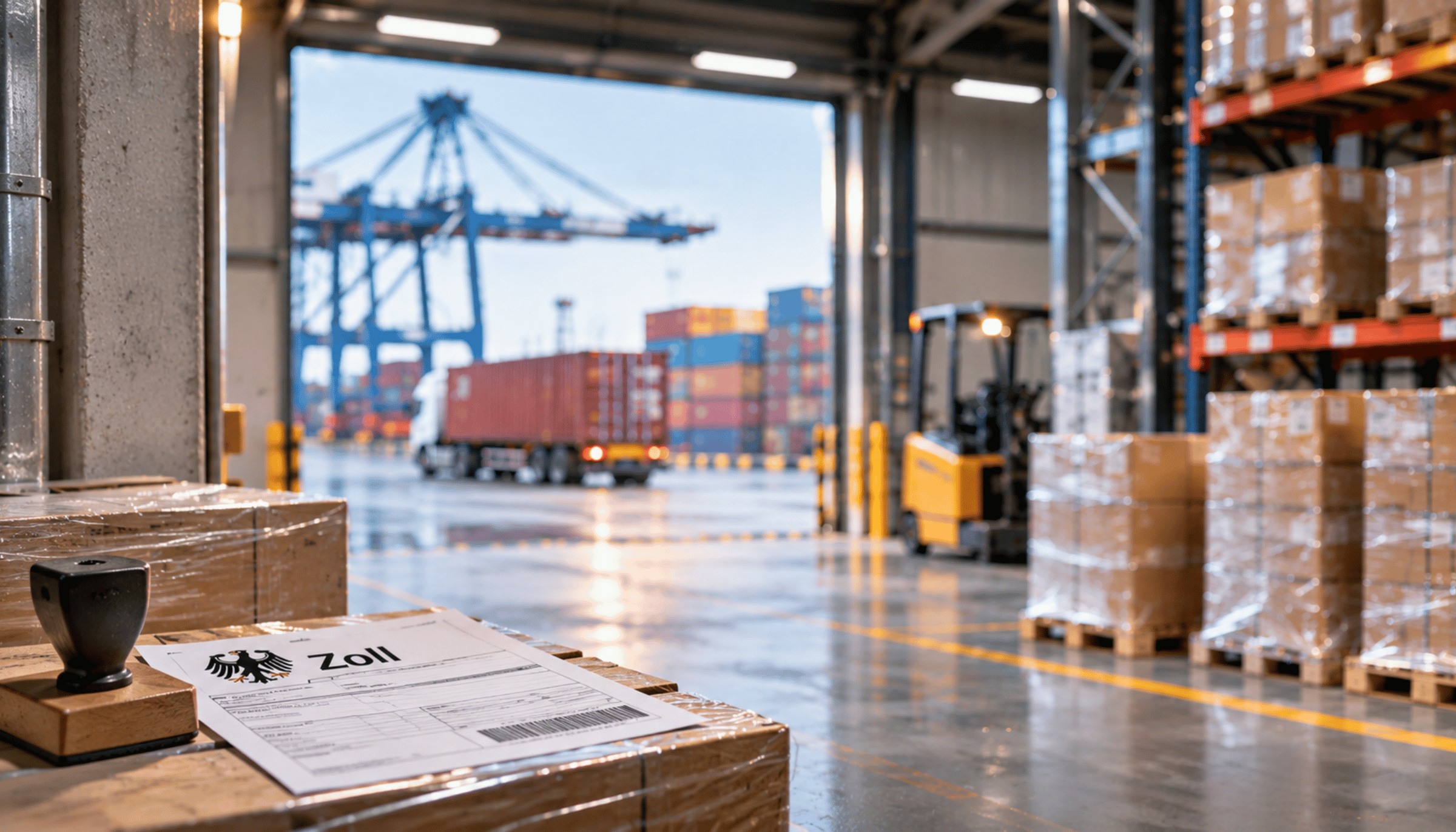
A container arrives at the Port of Hamburg, but the goods inside aren't needed for weeks or months. Do the import duties have to be paid immediately? Not necessarily. The customs warehousing procedure allows companies to store goods from non-EU countries under customs supervision without having to release them for free circulation immediately. This can offer financial and logistical advantages.
What exactly is a customs warehouse?
A customs warehouse is more than just an ordinary storage facility. It is a location approved by customs authorities where so-called non-Union goods can be stored under customs supervision.
The key feature: As long as the goods are properly held under the customs warehousing procedure, no import duties or import VAT are generally incurred. Although the products are physically located within the European Union, they have not yet been released for free circulation.
Only when the goods are released for free circulation—for example, for sale within the EU—are the corresponding import duties levied in accordance with applicable regulations. The legal basis for this is the Union Customs Code (UCC), which governs, among other things, the requirements for the customs warehousing procedure and customs supervision.
An example from the Port of Hamburg
A trading company imports 500 pallets of products from Asia. The shipment arrives in Hamburg in November, but a large portion of the goods won't be needed until the spring. If the goods were released for free circulation immediately, import duties would have to be accounted for on the entire shipment right away.
Alternatively, the goods can be placed in an approved customs warehouse. They remain there under customs supervision until the company decides how they will be used. If the importer only needs 100 pallets initially, these can be removed from the customs warehouse and released for free circulation. The remaining 400 pallets stay under the customs warehousing procedure.
As a result, import duties are generally only due on the partial quantities actually released for free circulation.
What are the benefits of a customs warehouse?
The most important advantage is the deferral of import duties. Companies do not have to pay customs duties and import VAT on goods that may not be needed for months. This can improve liquidity and reduce capital commitment. For companies entitled to input tax deductions, import VAT is generally more a matter of liquidity than a final cost burden.
In addition, there is greater flexibility in distributing goods. Imported products can be stored initially and then gradually released into the EU market based on demand.
The procedure can also be attractive for companies that resell goods outside the EU. If the stored non-Union goods are properly re-exported, they generally do not need to be released for free circulation beforehand.
A customs warehouse can therefore be particularly useful for international trading companies, seasonal importers, and businesses with large inventories.
Customs warehouse or temporary storage?
Not every duty-unpaid good located in the Port of Hamburg is automatically in a customs warehouse. After being presented to customs, non-Union goods are generally placed in what is known as temporary storage. This serves to keep goods under customs supervision until they are placed under a customs procedure or re-exported.
Temporary storage is generally limited to a maximum of 90 days. The customs warehousing procedure differs significantly: there is generally no time limit on the storage duration. However, customs authorities may set deadlines in certain cases. This makes the customs warehouse particularly suitable for goods whose final use is not yet determined or that are intended to be stored for a longer period.
What types of customs warehouses are there?
A distinction is generally made between public and private customs warehouses. Public customs warehouses can be used for the storage of goods from various companies. They offer importers a way to use the procedure without having to operate a customs warehouse themselves.
Private customs warehouses are intended for the storage of goods by the respective authorization holder, who is also the holder of the customs warehousing procedure. The goods do not necessarily have to be owned by them.
Operating a customs warehouse requires the appropriate customs authorization. In addition, there are specific requirements for inventory management, documentation, and monitoring. Stored goods must remain traceable and identifiable at all times. Certain treatments, such as those for preserving goods or preparing them for distribution, are permitted under current regulations. However, general processing is not allowed under the customs warehousing procedure.
When is a customs warehouse worth it?
A customs warehouse is not economically viable for every import shipment. If you need goods immediately upon arrival, you may see little benefit from deferring duty payments. You must also factor in storage costs, administrative requirements, and potential additional transport.
The procedure becomes particularly attractive when large quantities of goods are to be stored over a longer period, introduced into the EU market gradually, or re-exported at a later date.
A comprehensive assessment is crucial: How high are the import duties? How long will the goods remain in storage? What are the additional costs? And how much financial flexibility is gained by deferring duty payments?
Customs and logistics go hand in hand
A customs warehouse is most effective when processes are coordinated across the entire supply chain. Questions regarding customs declarations, transport from the port to the warehouse, and subsequent removal from storage must be resolved before a shipment even arrives.
Clear responsibilities and seamless documentation are essential. Errors in inventory management or the termination of customs procedures can have significant legal consequences. For internationally active companies, warehousing is therefore not just a matter of available square footage, but a vital component of import and distribution planning.

A customs warehouse allows for the storage of non-Union goods under customs supervision without the immediate accrual of import duties and import VAT. This can improve liquidity and offer companies greater flexibility in the distribution of goods. Unlike temporary storage, there is generally no limit to the duration of storage. This procedure is particularly attractive for large import volumes, seasonal inventory, and goods that may potentially be re-exported. However, whether a customs warehouse is economically viable depends on storage costs, administrative requirements, and the intended use of the goods.