
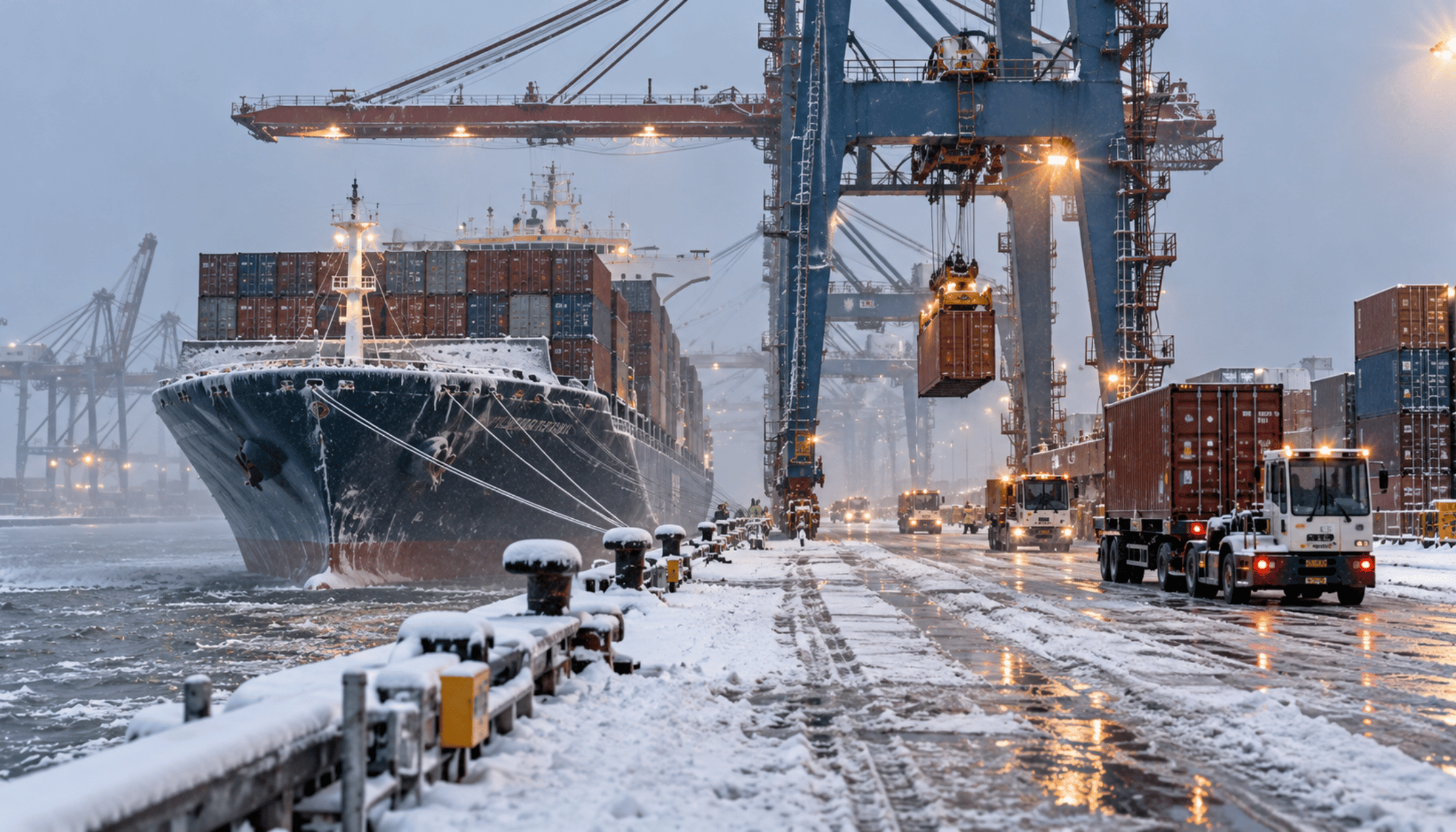
Winter at sea – how storms, ice, and fog impact global trade
Storms in the North Atlantic, icy container terminals, and limited visibility in ports: the winter months present unique challenges for international sea freight. The consequences extend far beyond shipping—reaching into the warehouses and production facilities of the recipients.
Between November and March, weather conditions on major trade routes can deteriorate significantly. Low-pressure systems move across the North Atlantic, strong winds complicate navigation in the North and Baltic Seas, and snow and ice hinder operations in Northern European ports.
For shipping lines, freight forwarders, and shippers, this means additional uncertainty. Even if a container ship reaches its destination port almost on time, bad weather can delay subsequent handling. The sensitivity of these processes was demonstrated in the Port of Hamburg in January 2026.
Storms at sea: safety over speed
Especially in the North Atlantic and the North Sea, ships must contend with severe storms and heavy seas during the winter. Powerful low-pressure systems can generate significant wave heights in a short time, increasing the stress on both the ship and its cargo.
Modern container ships are designed for demanding weather conditions. Nevertheless, heavy rolling and pitching can exert significant forces on containers on deck. Proper cargo securing is therefore essential.
When storms are forecast, ship captains may reduce speed, change course, or steer clear of particularly hazardous areas. Weather routing systems support these decisions based on meteorological forecasts.
The shortest route is therefore not always the fastest or safest connection. For shippers, such adjustments can mean that the originally planned estimated time of arrival (ETA) is pushed back.
Fog and poor visibility: when entering port takes longer
In addition to storms, fog and limited visibility can affect shipping. Poor visibility conditions make navigation difficult, especially in coastal regions, river estuaries, and port areas.
While modern merchant ships are equipped with radar, AIS, and electronic nautical charts, speed, safety distances, and traffic conditions must still be taken into account at all times.
In heavily frequented areas like the Elbe, port maneuvers and river passages can be restricted during poor visibility. Whether and to what extent this happens depends on the specific conditions and applicable safety regulations.
If a ship misses its scheduled terminal time slot as a result, berth allocation may be delayed. This delay can then potentially affect container handling and subsequent onward transport.
Ice and snow: when container terminals slow down
Winter conditions can also have significant impacts on land. Container terminals are complex facilities where cranes, transport vehicles, rail systems, and truck processing are closely integrated.
Icy container surfaces, snow-covered paths, or frozen locking mechanisms can delay cargo handling. Ice deposits on the corner fittings of containers, known as corner castings, are particularly problematic. These may need to be cleared before containers can be lifted safely.
Added to this are potential restrictions on rail switches, shunting areas, and road connections. Even if the actual container handling continues, other parts of the transport chain can grind to a halt.
The consequences are longer dwell times, reduced handling capacities, and additional strain on port logistics.
Hamburg in January 2026: winter weather with noticeable consequences
How quickly winter conditions can affect logistics was demonstrated in the Port of Hamburg at the beginning of January 2026.
Snow, ice, and persistent sub-zero temperatures hampered operations at several container terminals. As the NDR reported on January 7, ice-covered containers sometimes had to be cleared by hand before they could be lifted. During heavy snowfall, even self-driving terminal vehicles in Altenwerder occasionally had difficulty navigating.
ndr.de
The shipping company Maersk reported significantly reduced productivity at Hamburg terminals and depots. Snow-covered and icy roads caused delays in truck traffic. In rail transport, frozen switches were among the factors leading to disruptions and train cancellations.
Maersk
The extent of the impact is illustrated by reports from Eurogate Intermodal on January 7, 2026: At that time, loading delays of approximately 48 hours were reported at the Altenwerder container terminal, 60 hours at Burchardkai, and 72 hours at EUROKOMBI for rail and terminal operations. This was a snapshot of the respective handling situation at the time, not a general waiting time for all containers.
Eurogate Intermodal
Other Northern European ports were also affected. Shipping companies had to adjust their schedules. Maersk announced, among other things, that some ships might skip Hamburg and discharge cargo in Wilhelmshaven or Bremerhaven instead.
Maersk
This example illustrates that even a few days of extreme weather conditions can have far-reaching consequences for international supply chains.
The domino effect: From ship to recipient
In container logistics, one transport segment depends on the next. If a ship is delayed, downstream processes are often pushed back as well.
Containers are discharged and made available for pickup later than planned. Previously booked trucks, rail capacity, or warehouse appointments may need to be rescheduled. If several delayed ships arrive within a short period, the strain on terminals and hinterland transport increases further.
For importers, this can mean delayed availability of goods, higher storage costs, or production planning issues. Demurrage and detention charges may also arise if agreed-upon free time is exceeded. However, weather-related delays do not automatically lead to such additional costs. The decisive factors are the respective contract terms, free time, and specific circumstances.
In the export business, there is a risk that containers may not arrive at the terminal in time for the closing due to winter restrictions and will have to be rebooked for a later sailing.
Added to this is the international interconnectedness of liner services: a ship that is delayed in Northern Europe may carry this delay along its further route. If connecting feeder ship services are missed, the total transport time may be extended even further.
Winter weather is therefore not an isolated problem for individual ports, but can affect entire transport chains.
What importers and exporters should keep in mind
Winter weather events cannot be prevented. However, their impact can be limited through proactive transport planning.
- Plan for realistic time buffers: Potential delays should be taken into account, especially for time-sensitive goods.
- Check vessel arrivals regularly: The reported ETA is not a guarantee of arrival. Up-to-date status reports make it easier to adjust subsequent transport.
- Coordinate hinterland transport early: Truck and rail capacities should be coordinated as closely as possible with actual container availability.
- Know your free time and cost regulations: Agreed-upon demurrage and detention free time helps in estimating potential additional costs.
- Explore alternatives: Depending on the route and availability, different departure dates, ports, or modes of transport may be sensible.
- Ensure communication: Clear responsibilities and short lines of communication make it easier to react to last-minute changes.
Proactive planning instead of last-minute improvisation
Winter is one of the recurring challenges in international ocean freight. The decisive factor is therefore not just whether delays occur, but how quickly the companies involved can react to them.
For FR8 Logistik GmbH, an internationally active ocean freight forwarder based in Hamburg, the coordination between sea transport, port handling, and hinterland transport plays a central role. Up-to-date transport information, early planning, and cooperation with reliable partners help in responding to changing conditions.
Ultimately, a resilient supply chain is not defined by the absence of disruptions. What matters is that it continues to function as reliably as possible, even when the original schedule can no longer be met.

Storms, fog, snow, and ice can impact international ocean freight in a variety of ways. While heavy seas can lead to reduced speeds and route changes, winter conditions in ports cause restrictions in container handling and hinterland transport. The onset of winter at the Port of Hamburg in January 2026 demonstrated how quickly this can result in significant delays. For importers and exporters, realistic time buffers, transparent transport information, and early coordination among all parties involved are therefore essential. While winter risks cannot be entirely eliminated, their impact can be mitigated through proactive planning.