
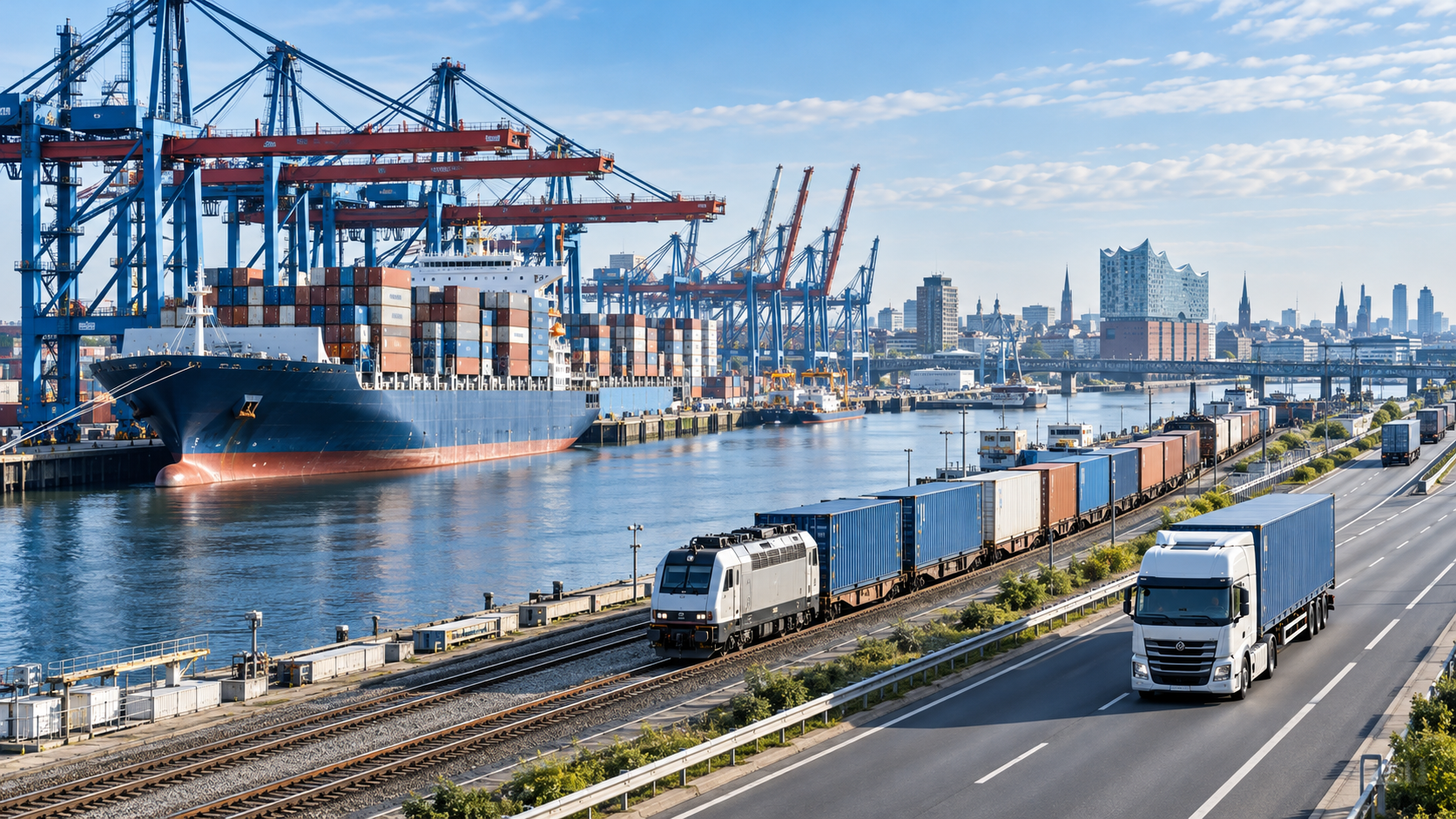
From Port to Warehouse: How Import Cargo Moves Through Germany
The Port of Hamburg moved around 2.6 million TEU into the hinterland in the first half of 2025, out of 4.2 million TEU handled, up 9.3 percent. Rail slots, driver capacity and ramp times are the scarce resources in this system: whoever secures them first runs efficiently. Whoever starts looking for them after discharge pays with waiting time, demurrage and empty runs.
What happens station by station between quay and ramp is covered in our guide from port to warehouse. This guide is about the question that comes before it: how do you plan that route so it works on the first attempt? The answer has three building blocks: data, mode choice and buffers.
2.6m TEU
Containers in the Port of Hamburg's hinterland transport in H1 2025
around 50%
Rail share of container hinterland traffic, Hamburg is considered Europe's largest rail port
3,879
Projects completed by FR8 Logistik GmbH in 2025
16,388 TEU
Containers loaded by FR8 Logistik GmbH in 2025
Building block 1: Planning starts at sea
Efficient on-carriage is not organized on arrival day but as soon as booking and ETA are in place. Container tracking provides the working basis: the reliable arrival time, transshipments and shifts, days before they become visible at the terminal. With this data, three things are prepared in parallel, not one after another: the import declaration, so that release does not become the bottleneck, the transport slot with the trucker or rail operator, and the unloading appointment at the consignee.
Complete information decides the pace: delivery address with ramp conditions, cargo weight for chassis and route, goods description for customs, requested date. Every missing detail costs a loop later, and loops in the on-carriage cost days.
Building block 2: Fix the transport mode per lane
Hamburg offers every option for the way inland: around half of the hinterland containers move by rail, and the port is considered Europe's largest rail port. The reasons why rail freight keeps growing are tangible: high capacity per train, plannable schedules and a significantly better CO2 footprint. For planning, though, this does not mean rail at any cost, it means: decide the mode once per lane, properly, and then run it repeatably.
Criterion
Favors truck
Favors rail or combination
Distance
Short runs, area around the port
Long runs to inland terminals in southern and western Germany
Volume and frequency
Single containers, irregular call-offs
Regular volumes on the same relation
Time window
Urgent shipment, fixed delivery date
Plannable demand with lead time
Destination
Ramp without terminal connection, last mile
Consignee close to an inland terminal
CO2 targets
Secondary over short distance
Companies with reporting duties, Scope 3 reduction
In practice it often comes down to the combination: rail to the inland terminal, truck for the last kilometers. What matters for efficiency is repeatability: a lane defined once, with fixed partners and slots, beats the weekly fresh decision on both cost and reliability.
Building block 3: Buffers belong in the plan, not in the excuse
Vessels run late, terminals congest, trains get cancelled. An efficient plan does not ignore this, it accounts for it. The most common causes and what they mean for scheduling are covered in our guide to container delays. For planning, one simple principle follows: every fixed date needs a defined reaction for the case that it breaks.
Concretely, that means: agree unloading appointments as time windows rather than precise minutes, actively rebook slots when the ETA shifts instead of letting them lapse, and for critical delivery dates plan unloading into a warehouse near the port as the buffer. There, the container is unloaded and returned empty independently of the consignee's ramp schedule, and the goods then move onward at the right pace. The buffer costs one handling step but saves demurrage, detention and broken delivery promises.
The 7-point checklist for efficient on-carriage
Set up ETA and tracking: follow arrival, transshipments and shifts continuously, from booking onwards.
Clarify documents upfront: commercial invoice, packing list, EORI and commodity code ready before arrival, so the import declaration is prepared.
Fix the mode per lane: truck, rail or combination, based on distance, volume and destination.
Lock slots to the ETA: book the trucker or rail slot as soon as the arrival time is reliable.
Agree the unloading appointment as a window: including staff and equipment at the consignee.
Plan the empty return too: depot, deadline and return leg belong in the same schedule as the delivery.
Define the fallback: when a delay or ramp failure hits, unloading into the warehouse kicks in instead of an improvised fix.
How FR8 Logistik GmbH plans the on-carriage
FR8 Logistik GmbH is an internationally active sea freight forwarder based in Hamburg, a member of the DSLV (German Association of Freight Forwarding and Logistics) and the Association of Hamburg Freight Forwarders (VHSp). In 2025 we completed 3,879 projects and loaded 16,388 TEU. Because sea freight, customs clearance and on-carriage sit in one hand with us, we plan the container transport by truck and rail together with the sea freight booking, not after arrival. One fixed contact person manages ETA, customs, slots and unloading appointments together, no ticket system.
If you want to make your import chain from Hamburg more plannable, send us the relation, volume and delivery address. You can request a quote and receive a concrete response within 24 hours.
Frequently asked questions about planning inland transport
When should inland transport be planned?
Before vessel arrival, ideally as soon as the booking is confirmed and a reliable ETA is available. Rail slots, driver capacity and unloading appointments are scarce and are allocated days to weeks in advance. Anyone who only starts scheduling after discharge burns the free time at the terminal with waiting and risks demurrage. The rule of thumb: once the ETA is reliable, the complete on-carriage is fixed, not merely requested.
Which information does the forwarder need for on-carriage planning?
The delivery address with ramp conditions and opening hours, the cargo weight for choosing chassis and route, goods details for the import declaration, the requested delivery date, and whether the container should be delivered directly or unloaded and stored. The earlier this information is complete, the better slots can be secured and empty runs avoided.
From which distance does rail beat the truck?
There is no fixed kilometer threshold. As a guide, longer runs to inland terminals, for example to southern or western Germany, favor rail, especially for regular volumes. Over short distances and for the last mile, the truck remains the standard. Besides distance, what matters is the consignee's proximity to an inland terminal, the predictability of volumes, and the company's CO2 targets. The combination of both modes is often the most efficient.
How do you plan unloading slots at the consignee correctly?
Fix the unloading appointment together with the transport, not afterwards. The slot should match the container's realistic availability, meaning customs release and terminal pickup are factored in, and it should be a time window rather than a precise minute. Ramp, staff and equipment must be ready at the consignee at that time, otherwise the truck waits at the shipment's expense. For uncertain arrivals, unloading into a warehouse is the more plannable alternative.
What should you do when the vessel is delayed?
Delays at sea are plannable when they are spotted early. Container tracking reveals ETA shifts days in advance. Trucker or rail slots and the unloading appointment are then actively rebooked before empty runs occur. What matters is scheduling that manages transport, customs and the consignee together: then a shift is one working step, not a chain reaction.

Efficient inland transport is not a reaction game but planning in three building blocks: reliable data from booking onwards, a mode decision made once per lane, and defined buffers for when things break. Locking slots and unloading appointments to the ETA gets the container off the terminal within the free time and avoids the costs no freight rate mentions. FR8 Logistik GmbH plans this route from Hamburg together with sea freight and customs, from a single source.