
Factory on the Move: Open Top, Heavy-Duty, and the Next Big Transports
Relocating an entire paper mill is no ordinary shipping job. While some containers are already on their way, loading continues at the original production site. A variety of transport solutions are being used—from open-top containers to planned flat-rack and RoRo shipments for particularly large machine components.
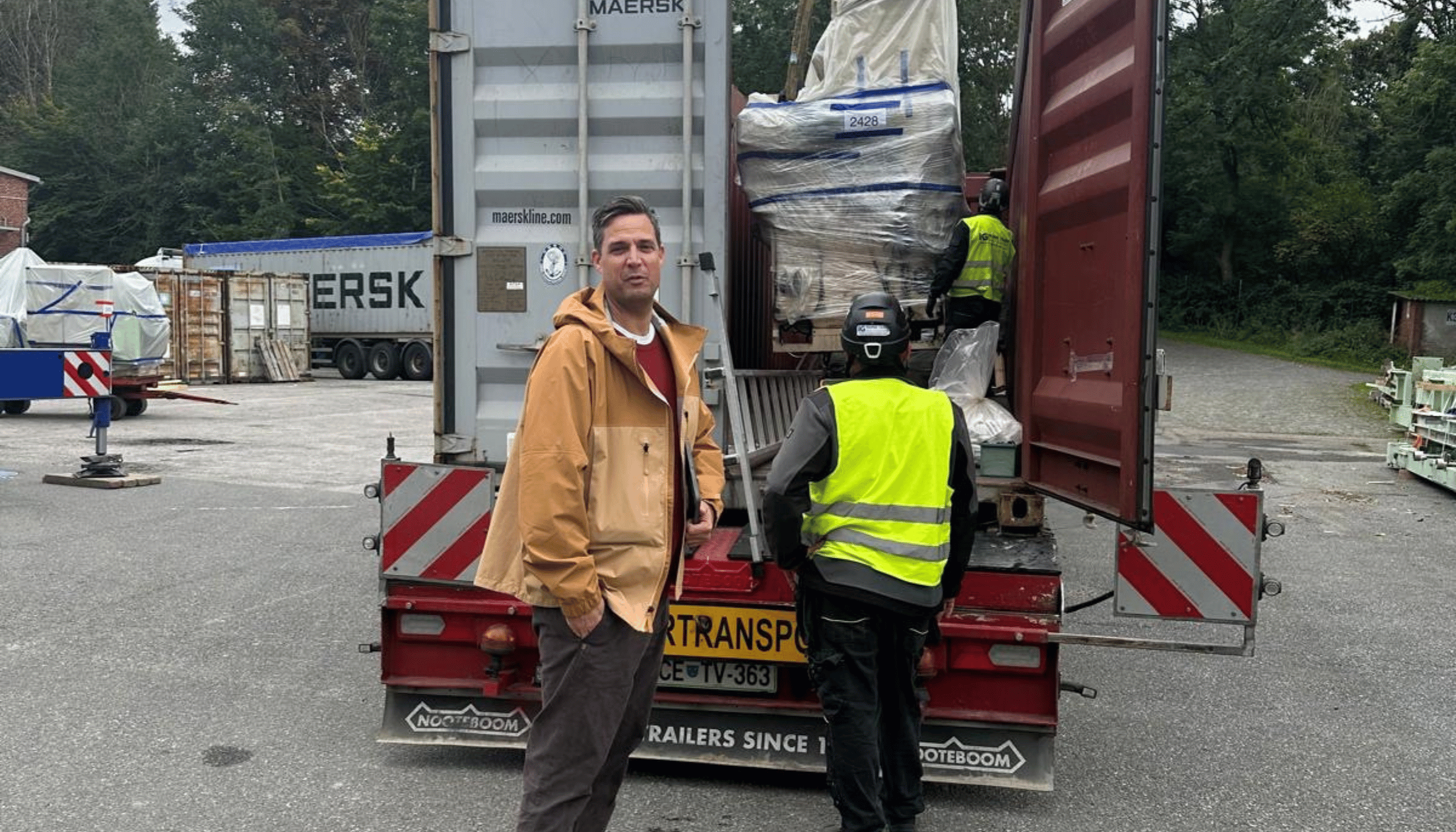
A large mobile crane lifts a heavy machine component into the air. Staff oversee the process while trucks and containers stand ready for the next steps. A few meters away, carefully packed plant components are being prepared for transport. The latest images from our "Factory on the Move" project provide an impressive look at the amount of hands-on work involved in relocating an entire industrial facility.
In previous parts of our series, we reported on the dismantling of the decommissioned paper mill, the procurement of suitable shipping containers, and the organization of international transport. The project has since progressed further. The first containers have already been dispatched, while work continues at the original site. After all, a factory cannot simply be shipped in one piece.
A factory relocation is not a single shipment
With standard container shipping, goods are often already packed and ready for pickup. In a factory relocation, logistical planning begins much earlier. Machines must be dismantled, components separated, sensitive parts protected, and individual pieces prepared for transport. The requirements vary significantly. Some machine components fit into a conventional shipping container, while others are too high, too wide, or too heavy for a standard solution.
Furthermore, not all plant components are ready for transport at the same time. While loaded containers have already left the factory premises, other components are still being dismantled, packed, and loaded. Different project phases are therefore running in parallel. The particular challenge lies in coordinating many individual shipments to create a functional, cohesive project.
Open Top: When machines are loaded from above
The latest footage shows a special type of container loading: the use of open-top containers. Unlike standard containers, these feature a removable roof cover. This allows heavy or bulky machine components to be lifted into the container from above using a crane.
This offers decisive advantages, especially during a factory relocation, as not every machine can be moved through the relatively narrow door opening of a container. When loading from above, suitable components can be lifted directly into their intended position. It must be checked in advance whether the cargo remains within the permissible dimensions or exceeds them.
In project logistics, a distinction is therefore made between two categories:
- In Gauge (IG): The cargo remains within the regular container profile.
- Out of Gauge (OOG): The cargo exceeds the regular container profile, for example in height or width.
This distinction is important for further transport planning, as oversized cargo can place special demands on stowage planning on the ship, cargo securing, and transport organization. An open-top container is therefore not just a container without a fixed roof; it is a specialized transport solution for cargo that cannot be loaded in the conventional way.
Precision work between mobile crane, truck, and container
A look at the latest photos shows just how demanding the practical implementation is. A mobile crane handles the lifting of the machine components. Staff members oversee the work and coordinate the positioning of the cargo. What looks like a single lifting operation from the outside requires careful preparation. Before loading, factors such as the machine's weight, suitable lifting points, the crane's load capacity, and the available space must be taken into account.
The subsequent positioning is also critical. After all, the cargo must not only fit into the container but also be placed securely and braced for further transport. Standardized solutions are not always possible, especially with older industrial plants. Varying machine dimensions, designs, and sensitive components require individual approaches.
The challenge, therefore, lies not just in lifting a machine. It must arrive at its intended destination safely and in a transport-ready condition.
Flat rack and RoRo: The big parts are still to come
The current open-top shipments are far from exhausting the range of required transport solutions. Further special transports are planned for particularly large machine components. Two options are primarily being considered: flat racks and RoRo.
Flat rack: For cargo outside standard dimensions
Flat racks are specialized container platforms without a fixed roof or continuous side walls. Depending on the design, they feature fixed or collapsible end walls. They are suitable for heavy or bulky goods that do not fit into a closed container due to their dimensions. This can include, for example, large machine components, industrial structures, or particularly wide plant parts.
The cargo is positioned on the platform and secured with appropriate lashing equipment. Depending on dimensions and weight, special transport permits may be required for the pre-carriage and on-carriage.
RoRo: When heavy cargo comes on board on wheels
RoRo stands for roll-on/roll-off. In this process, the cargo is moved onto the ship via ramps. This can be done either on its own wheels or with the help of suitable transport vehicles or special rolling platforms. RoRo is therefore also an attractive option for certain large industrial components that cannot be efficiently transported in a standard container.
Which solution is ultimately used depends on factors such as dimensions, weight, available shipping connections, and land transport requirements. For our factory relocation, the particularly large shipments using flat racks and RoRo are still ahead. First, the necessary permits must be obtained.
This means that various planning phases are already running in parallel: while the next open-top containers are being loaded, preparations for the upcoming special transports are underway.
While the first containers are on their way, the work continues
A special feature of our project is the temporal overlap of various work steps. While the first containers have already been dispatched, further components are being prepared for transport. At the same time, planning for the next special transports is ongoing. This requires continuous coordination between all parties involved. Dismantling companies, packaging specialists, crane operators, transport companies, and international logistics partners must synchronize their services.
For FR8 Logistik GmbH, this means, in particular, connecting the various transport stages. Organizing suitable containers is only one part of the task. In addition, there is the coordination of availability, the scheduling of transports, and the planning of the subsequent sea freight. Especially for projects with different types of cargo and multiple transport stages, forward-looking planning is crucial.
Because delays with a single component can have a ripple effect on subsequent work steps.
A factory gets a new perspective
A decommissioned paper mill does not necessarily mean that its machines can no longer be used. Under the right conditions, industrial plants can be dismantled, transported, and rebuilt at another location. However, numerous technical and logistical challenges must be solved to achieve this.
Our project is therefore not simply about shipping individual machines. It is about breaking down an extensive industrial plant into transportable units and moving the components to their new destination via various transport routes. The new images show what this process looks like in practice.
Heavy machinery is moved using crane technology, containers are loaded, and further specialized transports are prepared. What was once firmly tied to a production site is becoming mobile, step by step.
For FR8 Logistik GmbH, this is another exciting chapter in an extraordinary project. And our "Factory on the Move" series continues. FR8 Logistik GmbH – Moving things forward together.

The first containers are already on their way, with additional machine components to follow. The current open-top shipments demonstrate the level of precision required for a project of this scale. However, the next challenge is already waiting: flat-rack and RoRo transport solutions are planned for particularly large equipment components as soon as the necessary permits are secured. Our factory relocation impressively showcases what modern project logistics is all about. Not every machine fits into a standard container, but with the right planning, a suitable solution can be developed for any transport requirement.